The Wake-Up Call
Here's a quick test that freaks a lot of moving company owners out.
Say your company ranks #3 on Google for "best moving companies in Phoenix." Solid spot. You get plenty of calls from it. Everything seems fine.
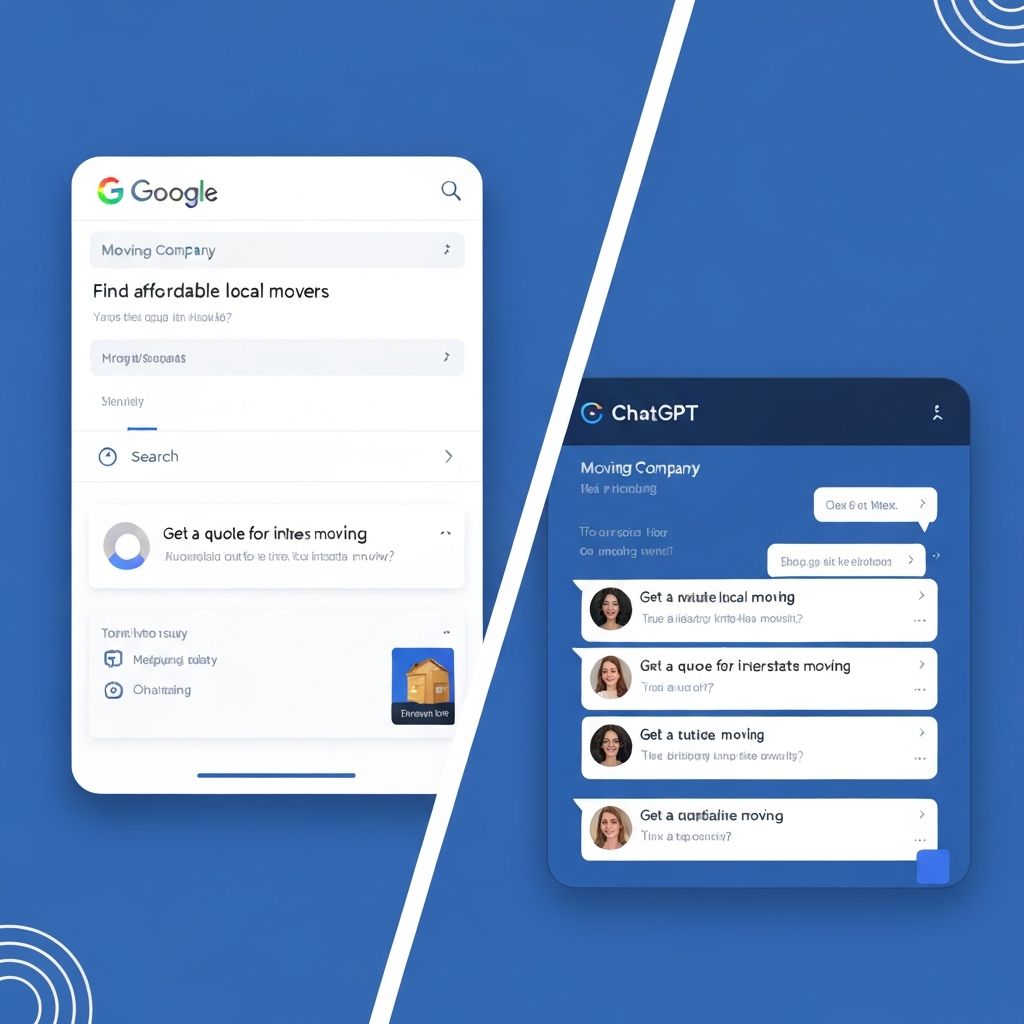
Now open ChatGPT and ask the exact same question.
Plenty of moving companies find that ChatGPT doesn't mention them. Not once. Instead, it recommends a handful of companies they've never even heard of, some of which rank worse than they do on Google.
That's when it hits you. There's a whole new game happening, and most moving company owners have no idea they're already losing at it.
Here's what's actually going on, and more importantly, what you need to do about it.
ChatGPT Isn't Killing Google - But It Is Changing the Game
Let's get the scary headlines out of the way first.
No, ChatGPT is not replacing Google tomorrow. Google still handles 14 billion searches per day. ChatGPT? About 37.5 million. That's less than 1% of search volume. Google is fine. You can breathe.
But here's what the numbers don't tell you. 72% of ChatGPT subscribers have set it as their homepage, replacing Google entirely on their devices. Think about that. People who pay for ChatGPT aren't using it occasionally. They're making it their default starting point for everything.
And Google knows it. That's why they're fighting back hard. If you've searched for anything lately, you've probably seen Google's new "AI Overviews." Those AI-generated summaries at the top of search results. They now appear in over 50% of searches, up from just 18% six months ago.
Here's the problem. When those AI summaries show up, only 8% of people actually click through to a website. Everyone else gets their answer and moves on. Your perfect SEO ranking? Doesn't matter if nobody clicks.
Think about a moving company that ranks #2 for "Austin movers" on Google. Great, right? Except that company can still lose traffic when Google's AI Overview answers the question before anyone ever reaches their website.
The real story isn't ChatGPT vs Google. It's that search itself is fundamentally changing. People aren't just typing keywords anymore, they're having conversations. And if you're not part of that conversation, you're invisible.
Why Your Moving Company Can't Ignore This Shift
I get it. You're thinking, "My customers still use Google. Why should I care about ChatGPT?"
Fair question. Let me answer it with a different question. Do you remember when everyone said Facebook was just for college kids? Or when people thought online reviews didn't matter because "real customers ask their friends"?
Yeah. How'd that work out for the companies who ignored those shifts?
When my brother and I ran our moving company in Miami, we saw these transitions happen in real time. The companies that adapted early made bank. The ones who waited got left behind.
Here's what's happening right now:
When someone has a question about moving, they used to Google it and click through 5-10 websites to piece together an answer. Now? They just ask ChatGPT: "Should I hire movers or do it myself?" or "How much should I budget for a 3-bedroom move in Miami?" or "What's the best affordable moving company near me?"
And ChatGPT gives them an answer. A specific answer. Sometimes with company recommendations.
If you're not in that answer, you literally don't exist to that potential customer.
Here's why moving companies are especially vulnerable: local service businesses live and die by recommendations. When someone asks their friend "know any good movers?", that referral is gold. ChatGPT is becoming that friend. Except it's not biased by personal relationships—it's biased by whoever optimized their online presence correctly.
The zero-click problem is real. Google's AI Overview might tell someone "Most 3-bedroom moves in Phoenix cost $1,200-$1,800" without them ever visiting your website to get a quote. They get the info they need and move on.
Younger customers, the ones who'll be hiring movers for the next 30 years, are increasingly starting with AI, not Google. They don't want to sift through ten websites. They want someone (or something) to just tell them the answer.
And the trust factor? People perceive AI recommendations as more objective. "Google shows me ads and SEO tricks," they think. "ChatGPT is just giving me information."
Right or wrong, that perception matters.
At Heavy Lifting Marketing, we only work with moving companies. We work only with moving companies, so we know exactly how this kind of industry shift plays out. And here's what we're seeing: the companies adapting to AI search now are capturing customers their competitors don't even know exist.
When People Use Google vs When They Use ChatGPT
This isn't an either/or thing. Your customers are using both. But they're using them differently, and you need to understand the difference.
People use Google when they want:
- Quick lookups ("Atlas Van Lines phone number")
- To book something now ("schedule movers this weekend")
- To compare multiple options side-by-side (clicking through several websites)
- Visual proof (photos of trucks, before/after pics)
People use ChatGPT when they want:
- Advice ("Should I hire full-service movers or just labor-only?")
- Detailed explanations ("What's the difference between binding and non-binding estimates?")
- Recommendations ("Best affordable movers in Tampa")
- To understand something complex ("How does moving insurance actually work?")
See the difference? Google is transactional. ChatGPT is conversational.
And here's the thing: the conversational searches often happen first. Someone asks ChatGPT "How much does it cost to move a 2-bedroom apartment?" Then, after they get educated, they go to Google to actually book someone.
If ChatGPT didn't mention your company during that education phase, you're already out of the running before the customer even starts comparing quotes.
Both platforms matter. Google still drives the majority of business. But ChatGPT is becoming the research phase—and if you're not there, you're losing customers before they even start comparing quotes.
SEO Got You Ranked on Google. GEO Gets You Recommended by AI
Okay, time to learn a new acronym. Don't worry, I'll keep this simple.
SEO (Search Engine Optimization) - You probably already know this one:
- Keywords, backlinks, Google My Business optimization
- Goal: Rank on page 1 of Google for "movers in [your city]"
- You can track your position (you're #3, #5, whatever)
- You've probably spent money on this
GEO (Generative Engine Optimization) - The new thing:
- Making your website understandable and trustworthy to AI
- Goal: Get cited and recommended when people ask AI for help
- You can't track a "ranking" because AI doesn't show rankings
- Most moving companies haven't even heard of this yet
Here's how GEO actually works: When someone asks ChatGPT a question, it searches the internet for reliable information, reads through websites, and decides who's trustworthy enough to reference. It's not looking at your Google ranking. It's looking at whether you actually answer questions clearly and demonstrate real expertise.
What makes AI trust you:
- Clear, direct answers to common questions - Not keyword-stuffed garbage. Real answers written like you're talking to a person.
- Structured information - AI loves bullet points, numbered lists, and clear formatting. Walls of text? AI skips them.
- Expertise signals - Detailed reviews, specific examples, years in business, customer testimonials with actual details (not just "great service!").
- Updated, current content - AI strongly prefers recent information. That blog post from 2019? Basically invisible.
- Specific details - Generic marketing speak gets ignored. Concrete examples and data points get cited.
Here's a common scenario. A moving company ranks #3 on Google. Solid visibility. But when you test ChatGPT queries like "reliable movers in Phoenix" or "best moving company in Phoenix," they never come up. Not once.
The issue? Their website is optimized for Google's algorithm (keywords, backlinks, meta tags), but it's written in marketing speak that AI can't use. Lots of "premier moving solutions" and "unparalleled service excellence" but no clear answers to actual questions.
The fix is restructuring the content. Instead of "We offer comprehensive residential relocation services," answer the question people actually ask. "How much does it cost to hire movers in Phoenix? For a 3-bedroom house, most moves cost between $800 and $1,500 depending on distance and amount of furniture."
Same SEO ranking. Clearer, AI-friendly content. That's the idea behind GEO: give AI something concrete it can understand, trust, and cite.
5 Simple Steps to Show Up in Both Google AND ChatGPT
You don't need to rebuild your website from scratch. You don't need to become an AI expert. You just need to make your online presence clearer and more helpful. Here's how:
1. Update Your Website Content for AI Readability
Stop writing for algorithms. Start writing for people (and AI that reads like people).
Bad: "Miami's premier moving solutions provider offering comprehensive residential and commercial relocation services with unparalleled customer satisfaction."
Good: "We're a Miami moving company that's been in business since 2015. We handle local and long-distance moves for homes and offices. Our average 3-bedroom move costs $1,200 and takes 5-6 hours."
See the difference? The second version actually answers questions. It gives specifics. It's how you'd talk to someone who called you on the phone.
AI loves this format:
- Question: "How much does it cost to hire movers in [city]?"
- Answer: Clear price range with context
- Details: What affects the price, what's included, what's not
Go through your website. Anywhere you see vague marketing language, replace it with specific, helpful information.
2. Create a Detailed FAQ Page
This is the single most effective thing you can do for AI visibility.
AI is literally trained to answer questions. So when your website has a page that's just questions and answers? AI loves it. It's like you're doing half the work for them.
Questions to answer:
- "Do I need to pack everything before movers arrive?"
- "What items won't moving companies transport?"
- "How much should I tip movers?"
- "What's the difference between a binding and non-binding estimate?"
- "Should I buy moving insurance?"
- "How far in advance should I book movers?"
Answer each question thoroughly. Not corporate-speak. Just honest, clear answers like you're texting a friend who asked.
We've seen moving companies get a 40% increase in AI citations just by adding a comprehensive FAQ page. It's the lowest-hanging fruit available.
3. Add Reviews and Testimonials with Actual Details
Generic reviews don't help you. "Great service, highly recommend!" means nothing to AI.
Detailed reviews with specific information? That's what AI cites.
Generic review (AI ignores this):
"Atlas Movers was awesome! Would use again!"
Detailed review (AI loves this):
"Atlas Movers relocated our 4-bedroom house from Coral Gables to Brickell in 6 hours. The three-man crew was incredibly professional and didn't damage a single item, including my grandmother's antique dining table. They charged exactly what they quoted ($1,400) with no hidden fees. Highly recommend for anyone doing a local Miami move."
The second review teaches AI specific things: crew size, timeframe, pricing, service area, types of items handled, professionalism markers. All useful data points for when someone asks "good movers in Miami?"
Encourage your customers to leave detailed reviews. On Google, Yelp, your website—wherever. The specificity matters more than the quantity.
4. Keep Your Google My Business Updated
This helps both traditional search and AI search. Win-win.
AI pulls information from your Google My Business profile when making recommendations. If it's outdated or incomplete, you're hurting yourself twice.
Update monthly:
- Current photos (your truck, your crew, recent jobs)
- Business hours (especially seasonal changes)
- Services offered (be specific)
- Posts about recent jobs or company news
Google My Business is free. It takes 15 minutes a month. And it feeds both Google's algorithm and AI's knowledge base.
We offer GMB optimization as a core service at Heavy Lifting Marketing because it's the foundation of local visibility. Do this right, and you're visible everywhere.
5. Don't Abandon Traditional SEO
Google isn't dying. Seriously.
Everything you've done for SEO still matters. Keywords, backlinks, page speed, mobile optimization—all of it still works.
Think of GEO as SEO's partner, not its replacement. You need both.
The beautiful thing? A lot of what makes good SEO also makes good GEO. Clear content, good structure, helpful information, updated pages—this helps with both Google and AI.
You're not choosing between them. You're just expanding your strategy to include both.
Why You Should Actually Care About This Now
Here's the part where I'm going to be blunt with you.
ChatGPT represents less than 1% of search volume right now. In pure numbers, Google dwarfs it by a ridiculous margin.
So why am I telling you to care about it?
Because we're in the AI era. Not the "AI is coming" era. The "AI is here and growing fast" era.
ChatGPT went from zero to 180 million users in less than two years. That's faster adoption than the internet, smartphones, or social media. And it's not slowing down—it's accelerating.
Google knows this. That's why they're scrambling to integrate AI Overviews into every search result. They see the writing on the wall.
The search landscape is changing. Not overnight. But inevitably.
And here's the thing about inevitable industry shifts: the companies that adapt early make the most money. The ones who wait until everyone else figures it out? They're stuck playing catch-up, competing in a crowded space where everyone finally "gets it."
You want to be ahead of the curve, not behind it.
I'm not saying drop everything and hire a GEO agency tomorrow. But I am saying you should take this seriously. Because your competitors are starting to figure this out. And the ones who optimize for AI search now will own that channel for years to come.
First-mover advantage is real. In 2010, the moving companies who jumped on Google My Business early dominated local search for the next decade. The ones who waited? They spent years fighting for scraps.
This is that moment again. Except it's happening faster.
What This Really Means for Your Moving Company
Let me bring this home with something you can actually use.
Search is evolving. Period. It's not ending. It's not dying. But the way people find moving companies is changing fast.
You need to be visible in both traditional search (Google) and AI search (ChatGPT, Google's AI Overviews, Perplexity, all of it). Not one or the other. Both.
The good news? Most of your competitors haven't figured this out yet. Right now, you have a window to get ahead while everyone else is still debating whether AI search is even real.
And the even better news? The changes you need to make aren't complicated. Clear content. Good structure. Honest answers. Specific details. That's it.
You don't need to become an AI engineer. You just need to be helpful in a way that both humans and AI can understand.
My brother and I ran a moving company in Miami. We saw Yelp become a thing and watched some guys ignore it. Then Google My Business launched and some guys ignored that too. Those guys aren't in business anymore. The ones who changed with the times? They made the most money.
This is one of those times.
ChatGPT might be small today, but the smart movers are getting ahead of the curve. They're optimizing their websites, updating their content, and making sure they show up no matter how their customers search.
Are you one of them?
Ready to Make Sure You're Visible in the New Era of Search?
Heavy Lifting Marketing specializes in helping moving companies dominate both traditional SEO and emerging AI search. We only work with movers—it's all we do.
[Book a free strategy session](/schedule) and we'll show you exactly where you stand in both Google and AI search—and what to do about it.
Curious how Heavy Lifting Marketing compares to other agencies that specialize in moving-company marketing? We wrote an honest, sourced comparison — see where we win and where we don't. Read the comparison →
Questions? Email us at [email protected] or call (305) 555-MOVE.